4 内積の公式の場合

次に、(3) について考える。この場合も事情は (2) とほぼ同じである。

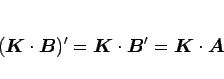
24 ページの (1.1) より、

\begin{displaymath}
(\mbox{\boldmath$K$}\cdot\mbox{\boldmath$B$})'=\mbox{\boldma...
...ox{\boldmath$B$}'
=\mbox{\boldmath$K$}\cdot\mbox{\boldmath$A$}
\end{displaymath}

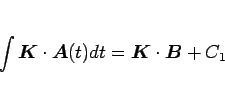
であるから、(3) の左辺は、
\begin{displaymath}
\int\mbox{\boldmath$K$}\cdot\mbox{\boldmath$A$}(t)dt = \mbox{\boldmath$K$}\cdot\mbox{\boldmath$B$}+C_1
\end{displaymath}

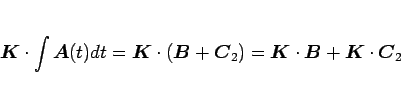
となる。一方、(3) の右辺は
\begin{displaymath}
\mbox{\boldmath$K$}\cdot\int\mbox{\boldmath$A$}(t)dt
= \mbo...
...ox{\boldmath$B$}+\mbox{\boldmath$K$}\cdot\mbox{\boldmath$C$}_2
\end{displaymath}

となるので、(3) が成り立つためには、
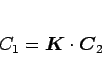
\begin{displaymath}
C_1=\mbox{\boldmath$K$}\cdot\mbox{\boldmath$C$}_2\end{displaymath} (9)

である必要がある。

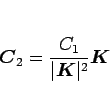
任意の $\mbox{\boldmath$C$}_2$ に対して、 (9) を満たす定数 $C_1$ は 常に取ることができるが、 任意の $C_1$ に対して、 (9) を満たす定ベクトル $\mbox{\boldmath$C$}_2$ は、 $\mbox{\boldmath$K$}\neq \mbox{\boldmath$0$}$ でないと取ることができない。 もし、 $\mbox{\boldmath$K$}\neq \mbox{\boldmath$0$}$ ならば、例えば

\begin{displaymath}
\mbox{\boldmath$C$}_2=\frac{C_1}{\vert\mbox{\boldmath$K$}\vert^2}\mbox{\boldmath$K$}
\end{displaymath}

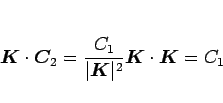
とすれば、
\begin{displaymath}
\mbox{\boldmath$K$}\cdot\mbox{\boldmath$C$}_2
=\frac{C_1}{\v...
...th$K$}\vert^2}\mbox{\boldmath$K$}\cdot\mbox{\boldmath$K$}
=C_1
\end{displaymath}

となり、確かに (9) を満たす。

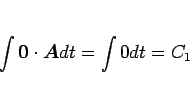
$\mbox{\boldmath$K$}=\mbox{\boldmath$0$}$ の場合は、 (3) の左辺は

\begin{displaymath}
\int\mbox{\boldmath$0$}\cdot\mbox{\boldmath$A$}dt = \int 0 dt = C_1
\end{displaymath}

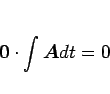
(3) の右辺は
\begin{displaymath}
\mbox{\boldmath$0$}\cdot\int\mbox{\boldmath$A$}dt = 0
\end{displaymath}

なので、 $\mbox{\boldmath$K$}=\mbox{\boldmath$0$}$ の場合は両辺を合わせるために 定数を入れて (6) としなければならないことがわかる。

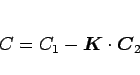
(6) であれば、$C$

\begin{displaymath}
C=C_1-\mbox{\boldmath$K$}\cdot\mbox{\boldmath$C$}_2
\end{displaymath}

とすればいいだけなので、正しく成立する。

竹野茂治@新潟工科大学
2007年5月8日